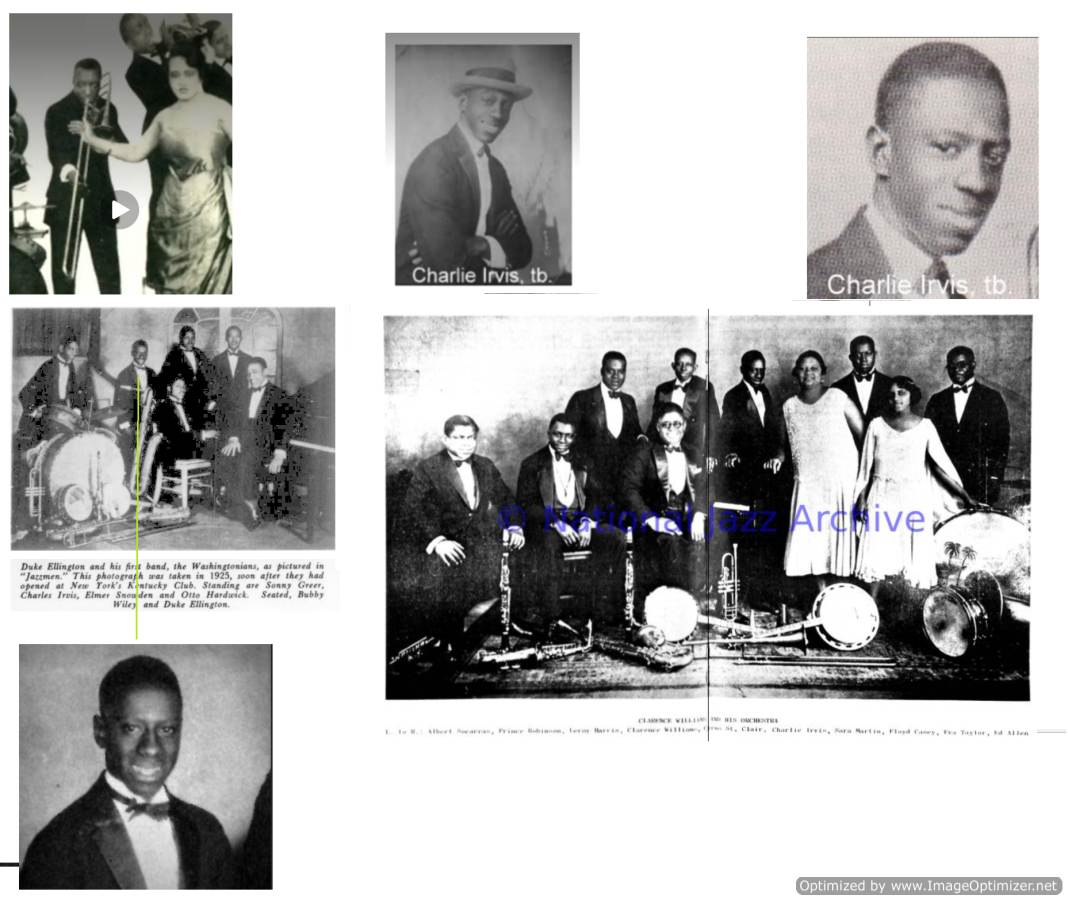
- Abel Green's description of the band in the 1923-11-23 Clipper has Bubber Miley on cornet and John Anderson doubling trombone and trumpet. Since Clipper was a weekly, Green may have attended the performance a week or more before its masthead date.
- Irvis was clearly in the band by mid-December, however. The Morning Telegraph, 1923-12-16 p.8:
If you think you have heard trombone players just drop into the Hollywood any evening after theatre time and hear the new trombone player there. The new artist made such a hit a few nights ago that Leo Bernstein signed a contract with him for the remainder of the season.
Frank Jerrie [sic], one of the partners of the Hollywood, discovered him a few weeks ago while on a trip to Bermuda and brought him to New York. George Hammond always has a front table every night since the new trombone player started and he will wager there is nothing quite so good as he in town... - The 1924-01-04 Clipper p.24 named him:
Charles Irvis is the new trombonist with the Washingtonians at the Hollywood, New York.
- Mr. Irvis was born in 1903, despite various books and webpages saying he was born in 1899. The books and webpages generally say he he died around 1939 but that has not yet been confirmed.
- Ellington (DownBeat 1962-06-07 p.20) as quoted by Stanley Dance in The World of Duke Ellington:
Well, take the people you hear playing plungers in the band. They derive their styles in part from Bubber Miley and Tricky Sam, but Charlie Irvis was first. Nobody ever really picked up on Charlie Irvis. He used an object that was very effective, and he played in a different register of the horn. There was a kind of mute they built at that time to go into the trombone and make it sound like a saxophone, but he dropped his one night and the darn thing broke into a million parts. So he picked up the biggest part that was left and started using it. This was his device and it was greater than the original thing. He got a great, big, fat sound at the bottom of the trombone – melodic, masculine, full of tremendous authority.
- Greer, quoted in Dance (ibid.)
Bubber was a great man with a plunger, but Charlie Irvis had an old tomato can, smashed in at the bottom like a cone, to get the same effect, those low notes and the growl. That was what Charlie was famous for, and everybody in the music buinsess knew him as 'Plug.'
- In his annotated Irvis discography found on his Harlem Fuss website (The Recordings of Charlie Irvis), jazz historian Karl-Bernd Rau describes Irvis' style as primarily legato with staccato at the beginning of phrases and his tone "rather straight with little vibrato with a rather antiquated punctuated phrasing."
- As boys, Charlie and Bubber Miley played in the same youth band. He recorded with Lucille Hegamin and her Blue Flame Syncopaters in 1921 and in 1923 recorded his first solo with Thomas Morris Past Jazz Masters on "Those Blues," composed by Bob [sic] Miley. He worked with Clarence Williams, Charlie Johnson, Fats Waller and Jelly Roll Morton (1929-1930), and later, with Bubber.
- Scott Yanow's Irvis biographical note says he played with Lucille Hegamin's Blue Flame Syncopators (1920-1921) and worked with Willie "The Lion" Smith. Chilton's Who's Who of Jazz, Storyville to Swing Street says the work with Smith was at Capitol Palace.
- Irvis stayed with The Washingtonians when Ellington became its leader in 1924. Ellington, Guy, Greer and Irvis joined the musicians' union local 802 by mid-1924 - see International Musician June 1924.
- He left Ellington in May 1926 to work with Charlie Johnson and was replaced by Joe Nanton. He appears to have worked on both union and non-union jobs:
- International Musician, Nov. 1925
- reinstated to Local 802 - International Musician, Oct. 1928
- reinstated to Local 802 - International Musician, Dec. 1929
- membership terminated
- International Musician, Nov. 1925
- Yanow [ibid.] tells us he worked with Charlie Johnson's Paradise Ten (1927-1928), toured with Jelly Roll Morton (1929-1930), recorded with Clarence Williams (1923-1927) and Fats Waller (1927 and 1929), and in 1931, played in Bubber Miley's band. Wikipedia says (at the time of writing) he worked with Snowden after Miley and Larkin (below) tells us he drifted into obscurity and died in 1939.
When was he born?
Several books and webpages suggest Irvis was born in or about 1899 and died around 1939, but don't identify their sources other, in some cases, to refer to each other:- Leonard Feather, in The New Edition of The Encyclopedia of Jazz, p.507 and his original 1955 The Encyclopedia of Jazz gives May 6 as Irvis' birthday, without suggesting the year.
- Ulanov, A Handbook Of Jazz (1957) p.184 says 1899-1939.
- John Chilton's Who's Who of Jazz, Storyville to Swing Street, (published 1978), says Born: New York city, c. 1899, Died New York City, c.1939, that his brother was Gibbie Irvis, and he began playing in a boy's band with Earle Howard, Bubber Miley, etc. "Gibbie" would be Gilbert - see census info below.
- Larkin's The Encyclopedia of Popular Music, p. 2713 ( published 1998), says "b. c.1899, possibly New York City, d. c.1939."
- Baker's Biographical Dictionary of Musicians, Vol. 3, p.1674 (published 2001), gives the same information, says Charles was the brother of pianist Gibbie Irvis and gives some career information. It names its sources as John Chilton's Who's Who of Jazz and Lewis Porter.
The United States federal censuses for 1905, 1910, 1920 and 1930 and the New York census 1925 establish Charles Irvis was born in 1903.
- 1905 U.S. federal census, enumerated June 1, 1905, 204 West 62nd Street:
Isaac Irvis (transcribed as Orvis), Head; Jennie, Wife; Children: Gertrude; Harry; Alfred; Chas (age 2 at last birthday); Gilbert (7 months old). - 1910 U.S. federal census, enumerated April 15, 1910; 570 Avenue C:
Father Isaac Irvis, Mother Jennie, Children:Gertrude; Harry; Alfred; Charles; Gilbert; Ruth; Aurthur (sic).
This census gives Charles' age as 6 at his last birthday (1909), establishing he was born in 1903. - 1920 U.S. federal census, enumerated Jan. 1920, 43 133rd Street,
Charles Irvis, age 16 at last birthday (1919) so born 1903.
Occupation, Polisher (Factory) - 1925 New York census, enumerated June 1925
36 133rd Street:
Charles Irvis, age 22 at last birthday (1925), so 1903 if he was born in May.
Occupation, musician
Living with Jennie Irvis, head, 44 years old; Gertrude Deverney, 26, (sister); Gilbert Irvis, 20 (brother) and Arthur Irvis (brother) 16. - 1930 U.S. federal census, enumeration as at April 1 1930
boarder, 64 W.133 St.
Musician
age 26 at last birthday, again indicating born 1903.